Sources
Code, dependencies, repositories, endpoints, certificates, cloud, protocols
Platform
RelixQ normalizes source and protocol evidence, maps HNDL exposure, preserves proof boundaries, and delivers the result to leadership, security operations, and engineering workflows.
Product architecture
Every scanner and workflow contributes to one normalized evidence chain rather than producing an isolated report.
Code, dependencies, repositories, endpoints, certificates, cloud, protocols
Normalized findings, assets, observations, provenance, confidence
Classification, scoring, HNDL windows, attack paths, policy
Signed-RoE observations, PQC Lab results, safe proof boundaries
Owners, exceptions, retests, reports, gates, audit history
API, SARIF, SIEM, observability, tickets, incidents, chat
Coverage
Evaluate source, configuration, dependency, TLS, cloud-key, cloud-TLS, and runtime coverage in one public matrix, with the readiness graph presented separately as correlation.
Connected operations
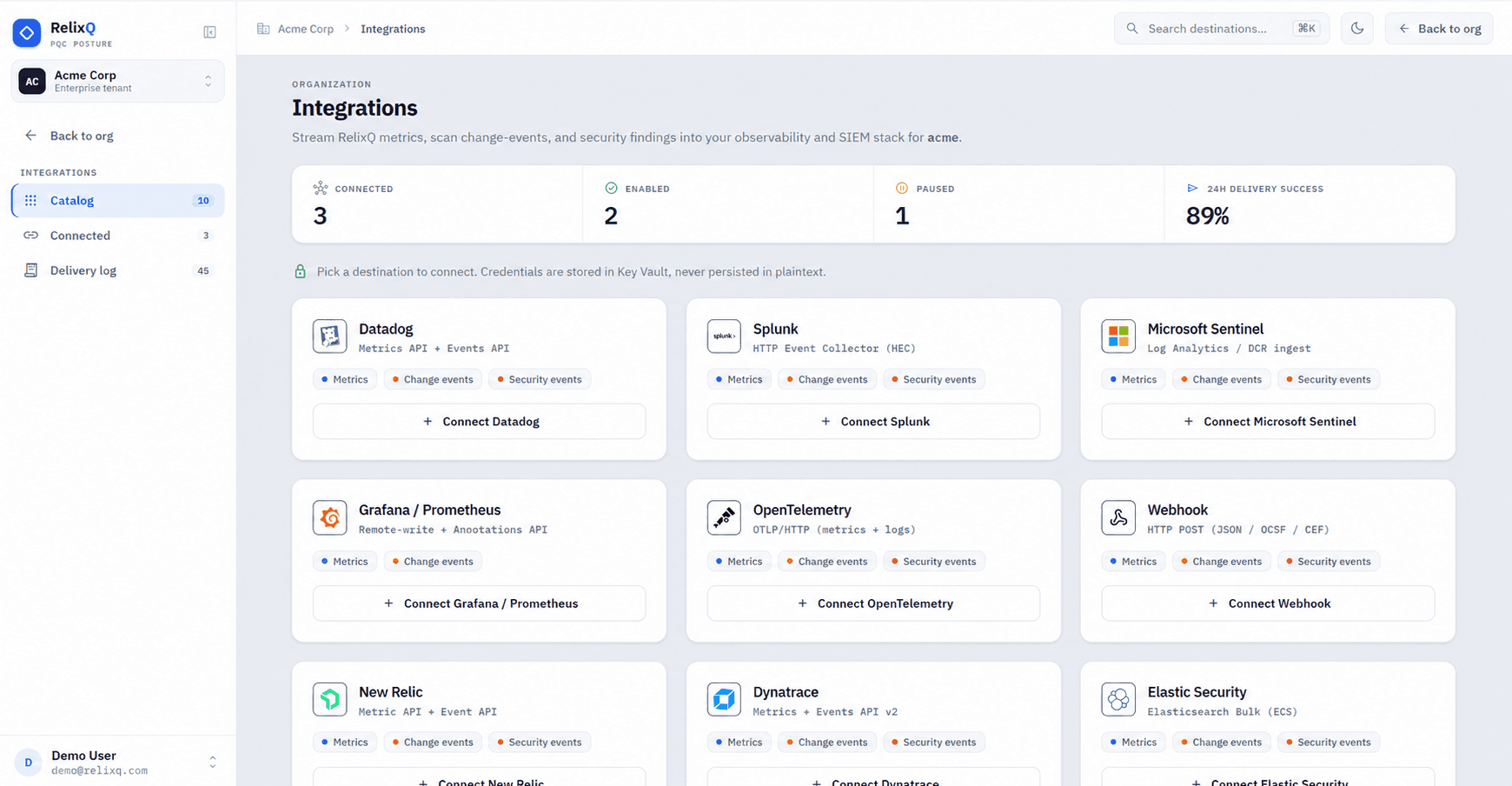
Connect source control, identity, cloud, and delivery workflows, then route posture to SIEM, observability, tickets, incidents, on-call, and chat.
Interoperability
Use widely adopted security and observability formats so RelixQ evidence can move through existing governance and engineering systems.
Quantum exposure assessment
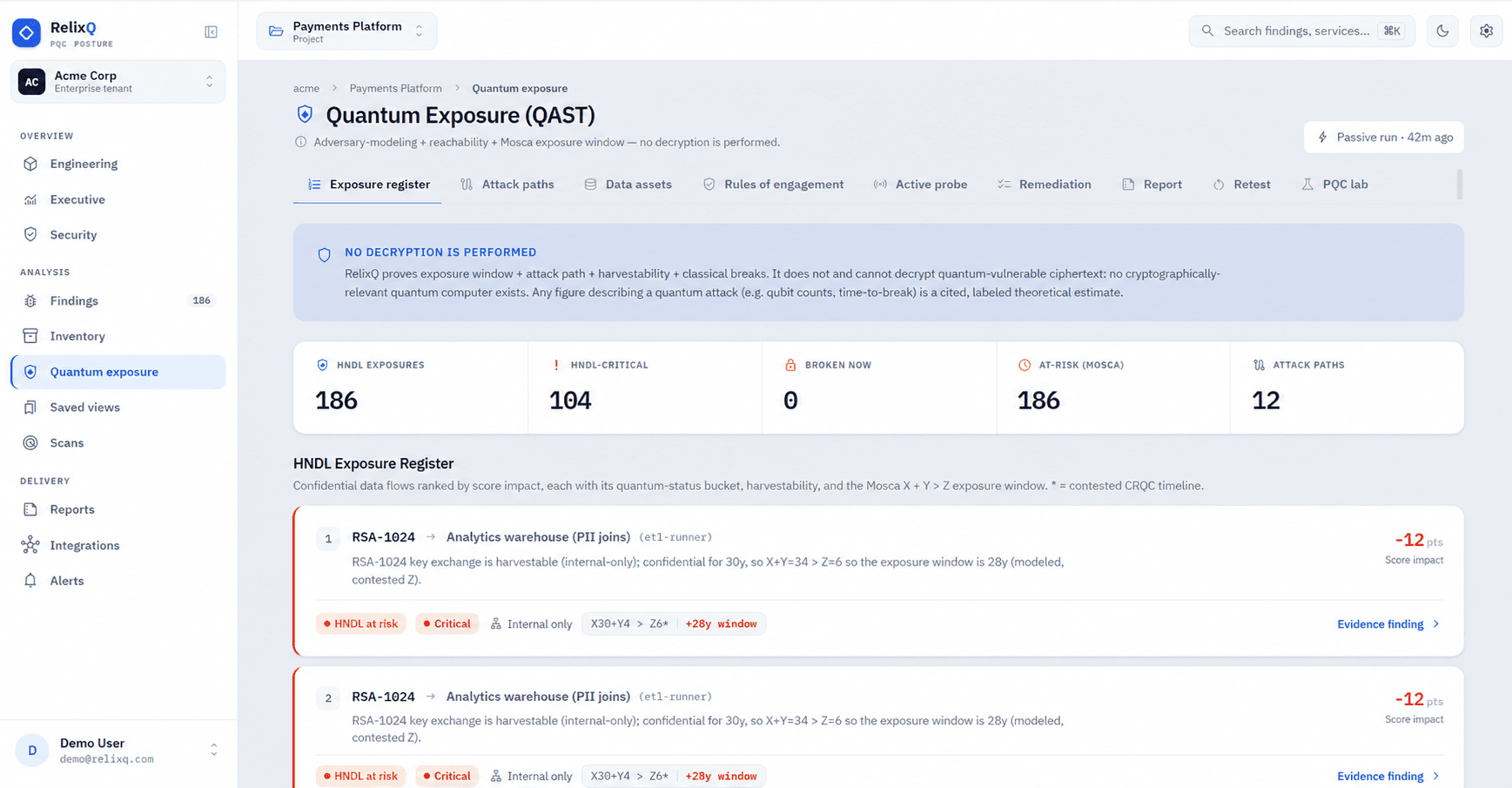
RelixQ classifies HNDL risk using data lifetime, harvestability, migration time, reachability, confidence, and explicit assumptions. Attack-path projection connects exposed entry points to the data assets that matter.
Leadership metric
The score is a 0–100 leadership signal backed by drivers, confidence, severity, exposure, trend, and next actions. Engineering can drill from the rollup into the findings and evidence responsible for movement.
Discovery and inventory
RelixQ normalizes cryptographic evidence across scanners so teams can investigate one consistent finding contract and generate a cryptographic bill of materials for migration planning.
Compatibility evidence
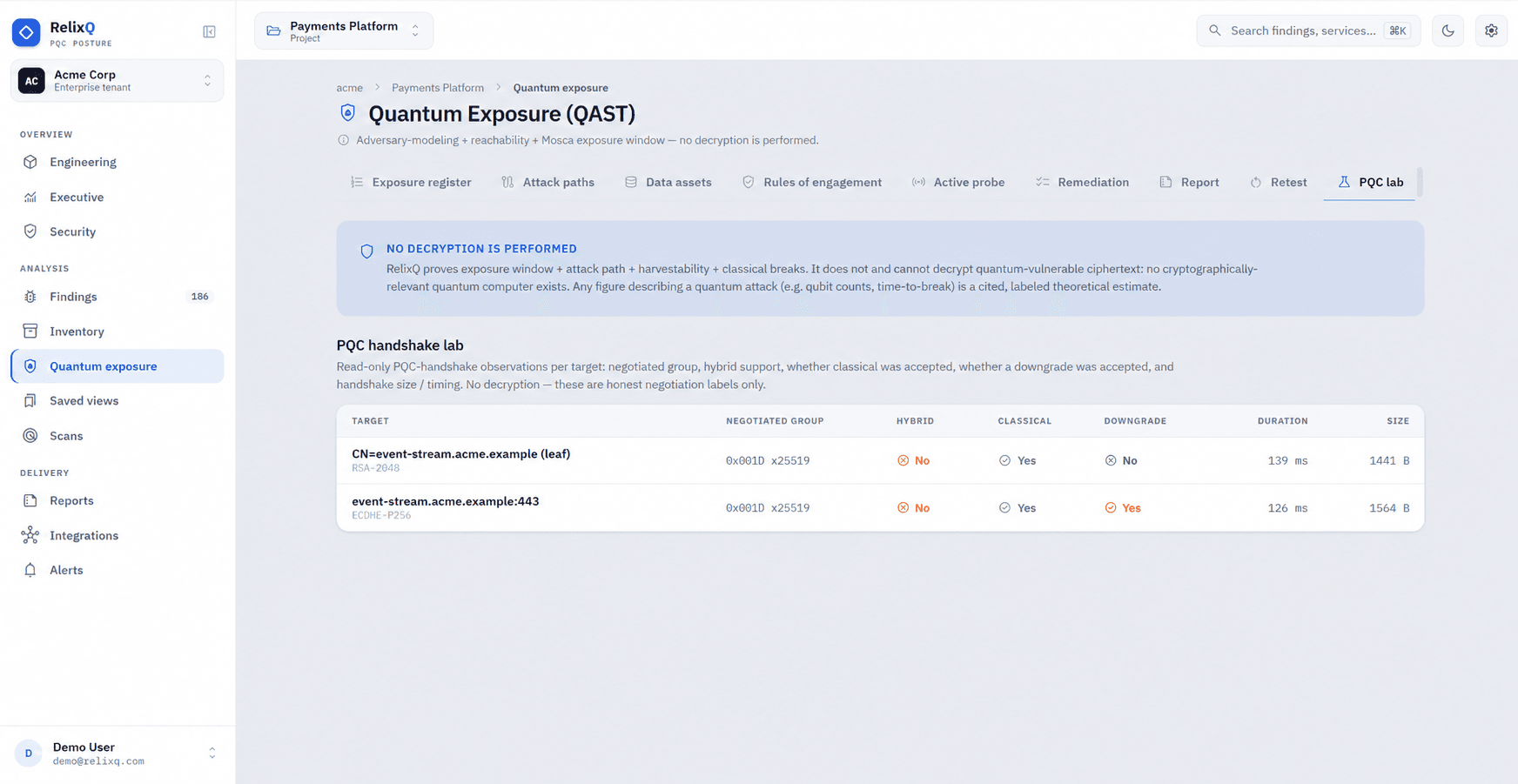
Read-only observations expose negotiated groups, hybrid support, classical acceptance, downgrade labels, handshake duration, and message size. Honest empty states remain visible until evidence is connected.
Product surfaces
Consistent screenshot treatment makes the product story concrete while preserving the status and honesty labels buyers need.
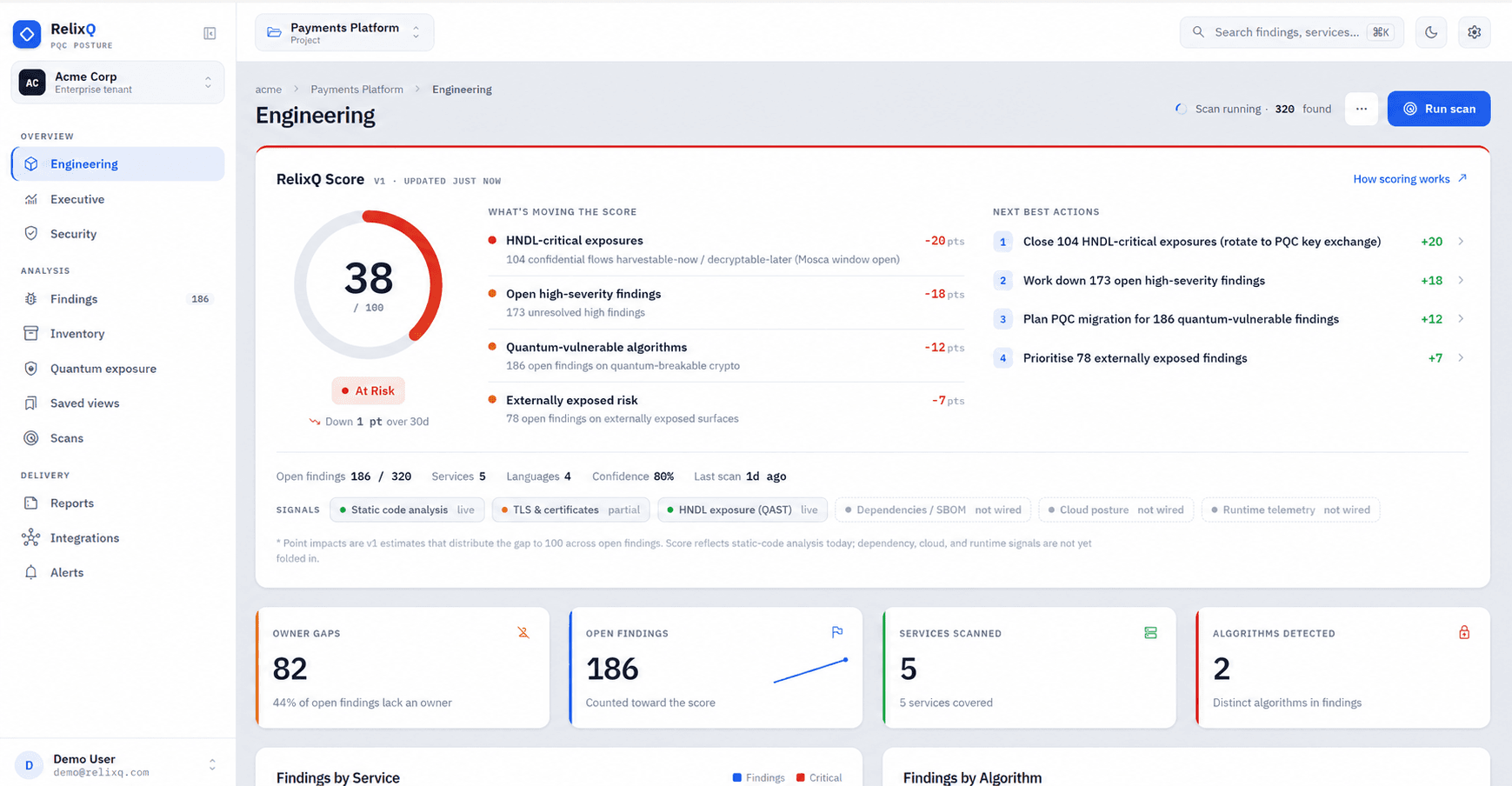
Engineering
RelixQ Score, HNDL-critical exposure, next actions, service context, and confidence in one working view.
QAST
Exposure windows, harvestability, reachability, and Mosca assumptions stay visible beside the result.
PQC Lab
Inspect negotiated groups, hybrid support, classical acceptance, downgrade labels, and handshake details.
Operations
Route posture and findings to SIEM, observability, ticketing, incident, chat, and webhook destinations.
Operating controls
Assessment value persists only when the same evidence drives decisions and developer behavior after the initial review.
Governance
Attach posture expectations, accepted risk, scope, owners, approvers, expiration, and audit history to the same project evidence.
CI and release gates
CLI and pipeline controls support SARIF, committed baselines, base-versus-head comparison, score thresholds, HNDL conditions, exception state, and regression checks.
Reports and integrations
Generate executive and technical artifacts, then route findings and posture changes into SIEM, observability, ticketing, incident, on-call, chat, or webhook systems.
Technical evaluation
Use the Developer Guide to examine workflows and evidence boundaries, then scope the application portfolio and operating integration for an Enterprise evaluation.